ENGLISH VERSION
EXHIBITION TEXTS

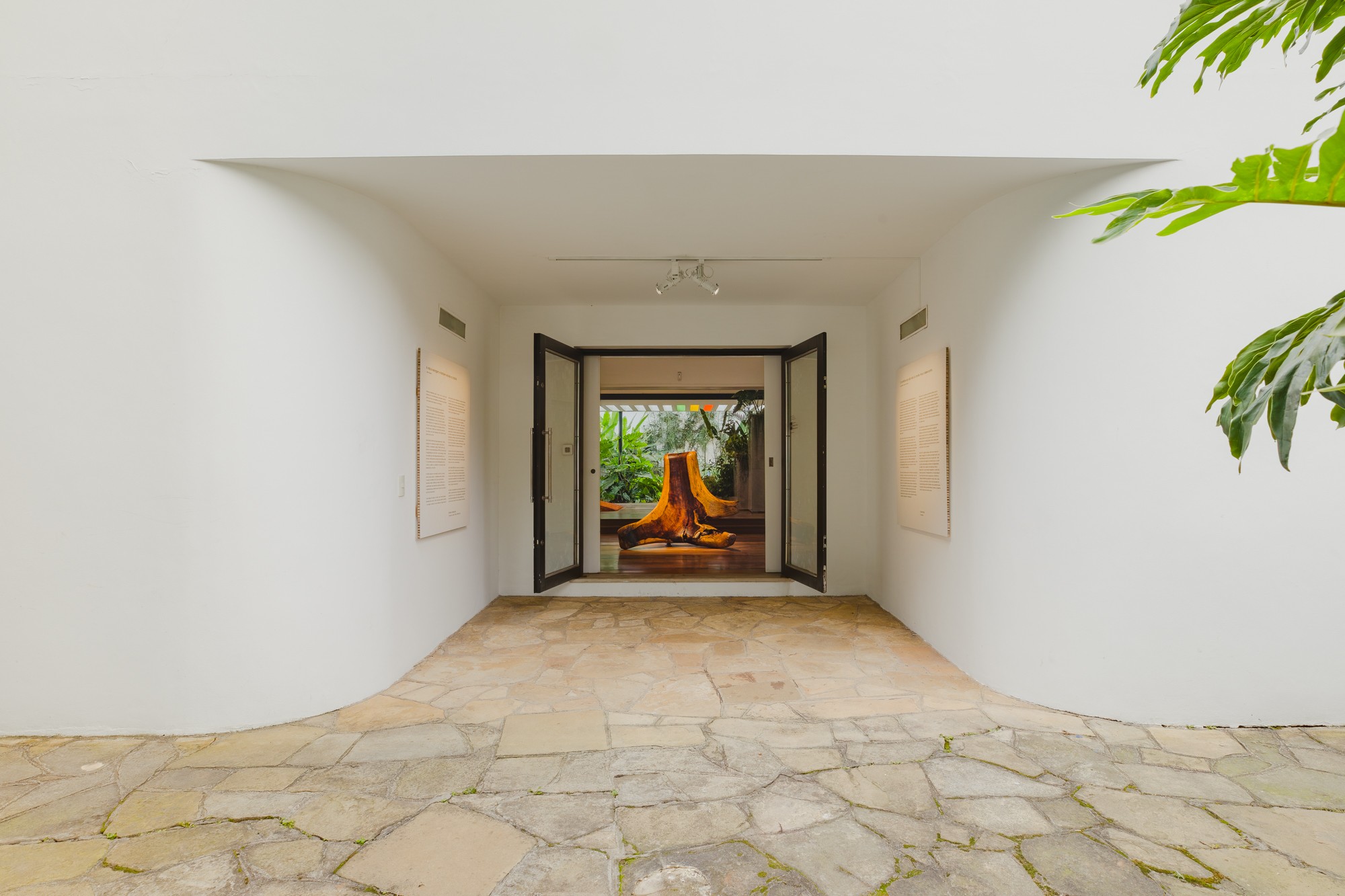

Life is wild,
and it also erupts in the city.
— Ailton Krenak
We inhabit different homes. The body, the dwelling, and the world we share with countless other beings. We are part of a whole, yet we persist in the fantasy that a barrier exists between nature and humanity.
The expansion of cities has normalized this separation; it has built structures of comfort that have gradually distanced us from the living system of which we are a part. A silent conflict has taken hold: between self and other, between survival and life. And nature responds with the very force upon which we imposed our civilization. Climate change is no longer a warning on the horizon. It is reality. And it demands something of us: that we rethink how we inhabit this great common home.
Casa Mundo Particular emerges from this tension. The title itself carries the structure of the project: CASA [home] names the everyday, intimacy, shelter. MUNDO [world] reminds us that no dwelling exists in isolation. PARTICULAR [particular] points to the singularity of each gaze — each person, artist, and community inhabiting this entanglement in their own way. The three words function in any order. Therein lies their strength: there is no fixed hierarchy between the intimate, the collective, and the planetary. There is circulation, friction, overlap, communion.
The exhibition proposes a movement contrary to urban expansion over green space — a symbolic reforestation of the domestic sphere. A house that ceases to be hermetic, solid, immutable, and instead allows itself to be contaminated by living possibilities: organic elements, memories, materialities that enter through its rooms and awaken what had lain dormant.
And this demands a shift in perception: what if the house were not designed for those who visit it, but for those who already inhabit it — fungi, roots, the light that enters at a low angle at six in the evening? Multispecies theory asks precisely this of us: to remove the human from the center and cultivate an empathetic imagination capable of entering other temporalities, other perceptions, other ways of growing. While scientists and politicians negotiate targets, art proposes something else: changing what we are capable of imagining.
The very site chosen to host the exhibition carries its own layers of meaning. Apartamento 61 occupies a residence designed in 1939 by Victor Brecheret — where the sculptor lived with his family — and renovated two decades later by Rino Levi. Dedicated to the preservation of twentieth-century Brazilian furniture, the gallery’s history already contains many of the questions raised by the exhibition itself: architecture, ecological thinking, circular economy. Yet this history does not remain a backdrop. The architecture affects the works; the works affect the architecture. Between space, object, and visitor, an ecology of relations takes shape.
The exhibition is curated by Lilian Fraiji. Born in the Amazon, she brings together art, nature, science, and ancestral knowledge, with particular attention to the relationships between culture, climate, and environmental justice. Hers is a perspective that inhabits, as the exhibition proposes, more than one home at once.
Casa Mundo Particular asserts itself as a territory of encounter and listening. A space where art, ecology, and architecture intertwine not to offer answers, but to cultivate questions: how might we coexist in more sensitive and sustainable ways? What forms of belonging remain possible? How do we inhabit the world beyond the logic of separation?
By proposing an experience that moves through both the sensory and the political, the project establishes a field of reflection in which care for life — in all its diversity — expands beyond the walls themselves. A house that breathes, welcomes, and opens itself: to the other, to time, and to the world.
Stefania Dzwigalska
Creator of Casa Mundo Particular
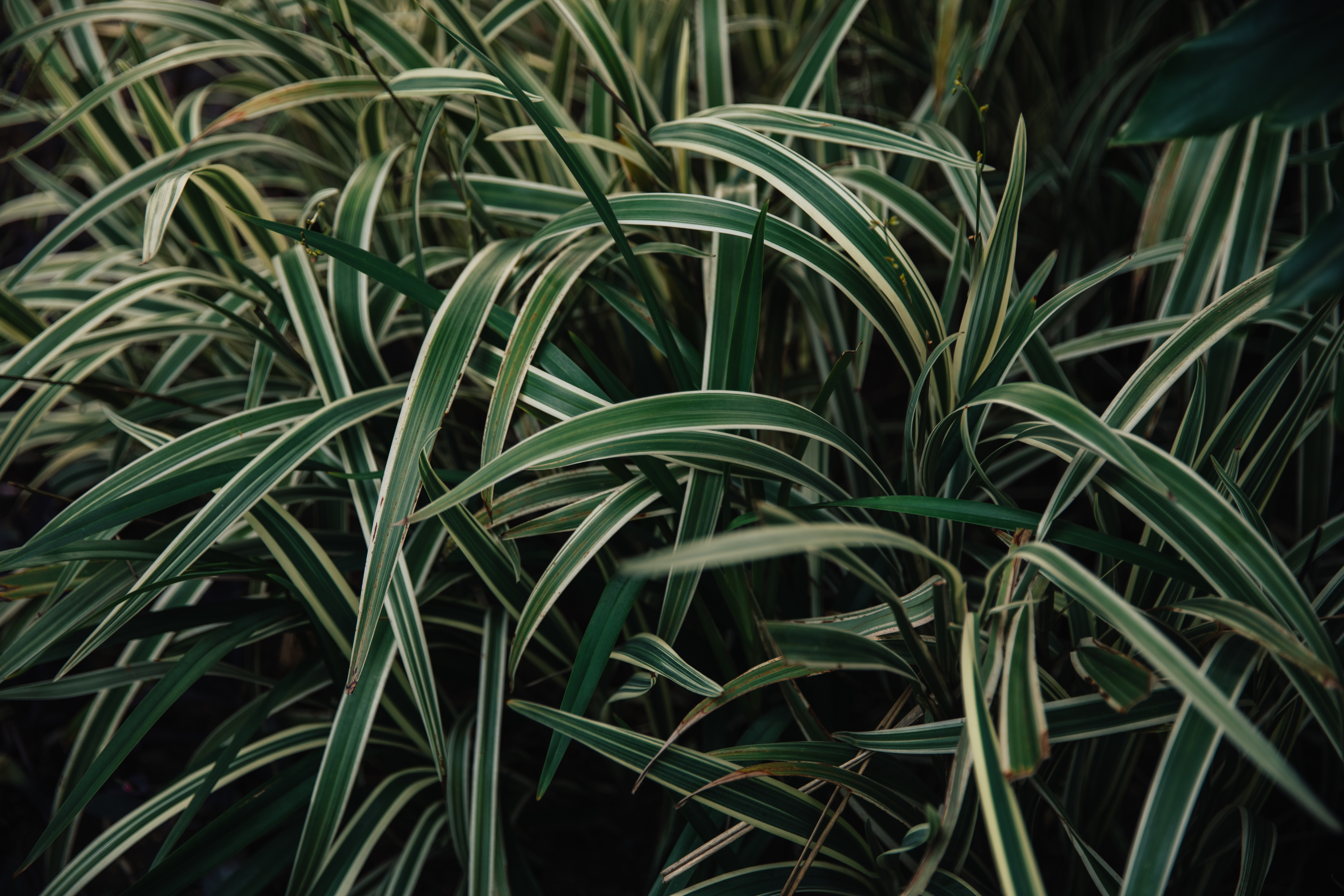
The opposite of life is not death,
but disenchantment.
— Luiz Rufino, Flecha no Tempo [Arrow Through Time]
The home is a possible space of shared and collective happiness, a catalogue of a possible world made of things, emotions, objects, people, plants, and animals. It is the intimate space of who we are, where the values we believe in take shape and where our lives intertwine with other lives, our destinies with other destinies. It is within the domestic sphere that we express and practice love, extending affection beyond the human as part of an ongoing dance of mutual domestication among lives, objects, and memories. If the home is a place for the exercise of love, sharing, and the creation of common worlds, how can we make the planet our home?
Casa Mundo Particular emerges from this question as a political gesture in favor of care — a call for the creation of spaces of renewal where we may imagine and practice, with courage and attentiveness, the future we desire. The exhibition proposes a displacement of the very notion of inhabiting, dissolving the boundaries that separate inside from outside, the intimate from the collective, the human from the nonhuman, in order to ground dwelling within the Earth itself. To inhabit, here, is to feel oneself woven into a continuous web of relations; it is to recognize oneself as part of a world that breathes alongside us, where interdependence ceases to be a concept and reveals itself as a condition of existence.
A house built as a territory of expanded perception — a space of listening to all that does not speak, of seeing what has not yet revealed itself, of opening oneself to what is felt before it can be named. A place where we allow ourselves to be affected, enveloped, and transformed; where we relearn how to become enchanted by the language of the world and by the living beauty that surrounds us. Here, encounter becomes a force, and through it we recognize ourselves implicated in what we are: relational, multiple, interconnected, and multispecies beings.
We have brought together a group of artistic works united by the power of cultivating becoming. Some emerge as gestures of denunciation, revealing the deep structures that connect the exploitation of human bodies and nature, resonating with questions of ecofeminism, environmental racism, and climate justice. Others unfold as fields of expanded listening and spirituality, important instruments for reconnecting with the Earth in times of the great acceleration of the Capitalocene. Some works delve into the dynamics of living beings in all their complexity, revering the invisible agencies of the microcosm, while others expose the marks of human intervention upon the landscape, denouncing the historical violence inscribed in rivers that remember. Amid displacements and transfigurations, bodies and spaces intertwine, projecting us simultaneously toward the cosmos and inward into ourselves.
If living is an ecological act, then every mode of inhabiting carries within it the potential for transformation. Casa Mundo Particular asserts itself as an active gesture — opening a field in which imagining is already a form of action: an invitation to cultivate other presences, to confront inequalities in the right to life, and to assume a radical implication in the world. To reenchant the home is also to resignify inhabiting itself. It is not enough to recognize interdependence; it is necessary to dispute its forms, intervene in its organization, confront the historical violences that silence life, and open the house, the body, and thought itself to other ways of existing. A sensitive house that dreams and insists upon life, that believes in its inventions, trusts in metamorphosis, and sows, in the present, other ways of living together.
Lilian Fraiji
Curator
ARTWORKS
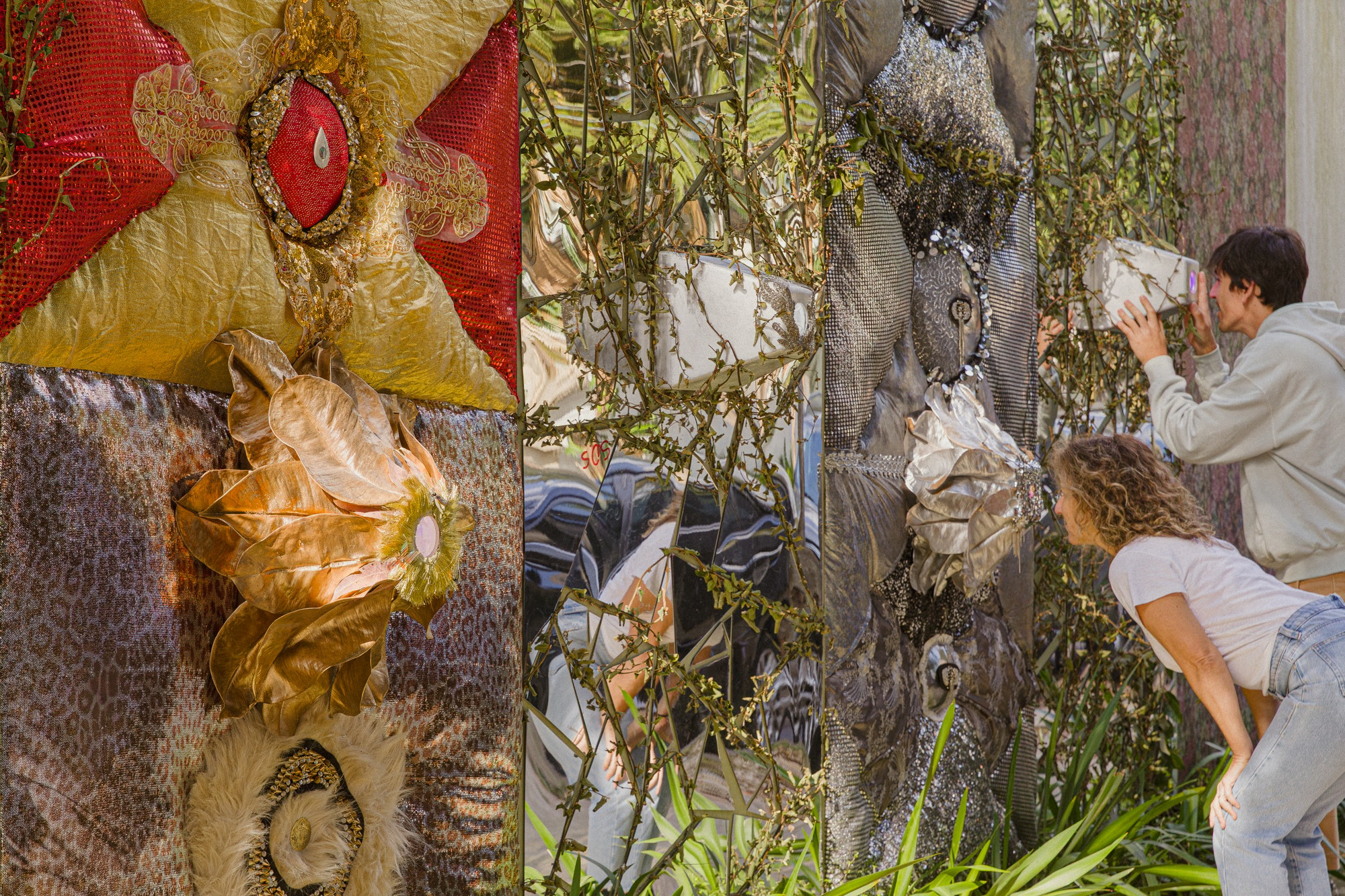
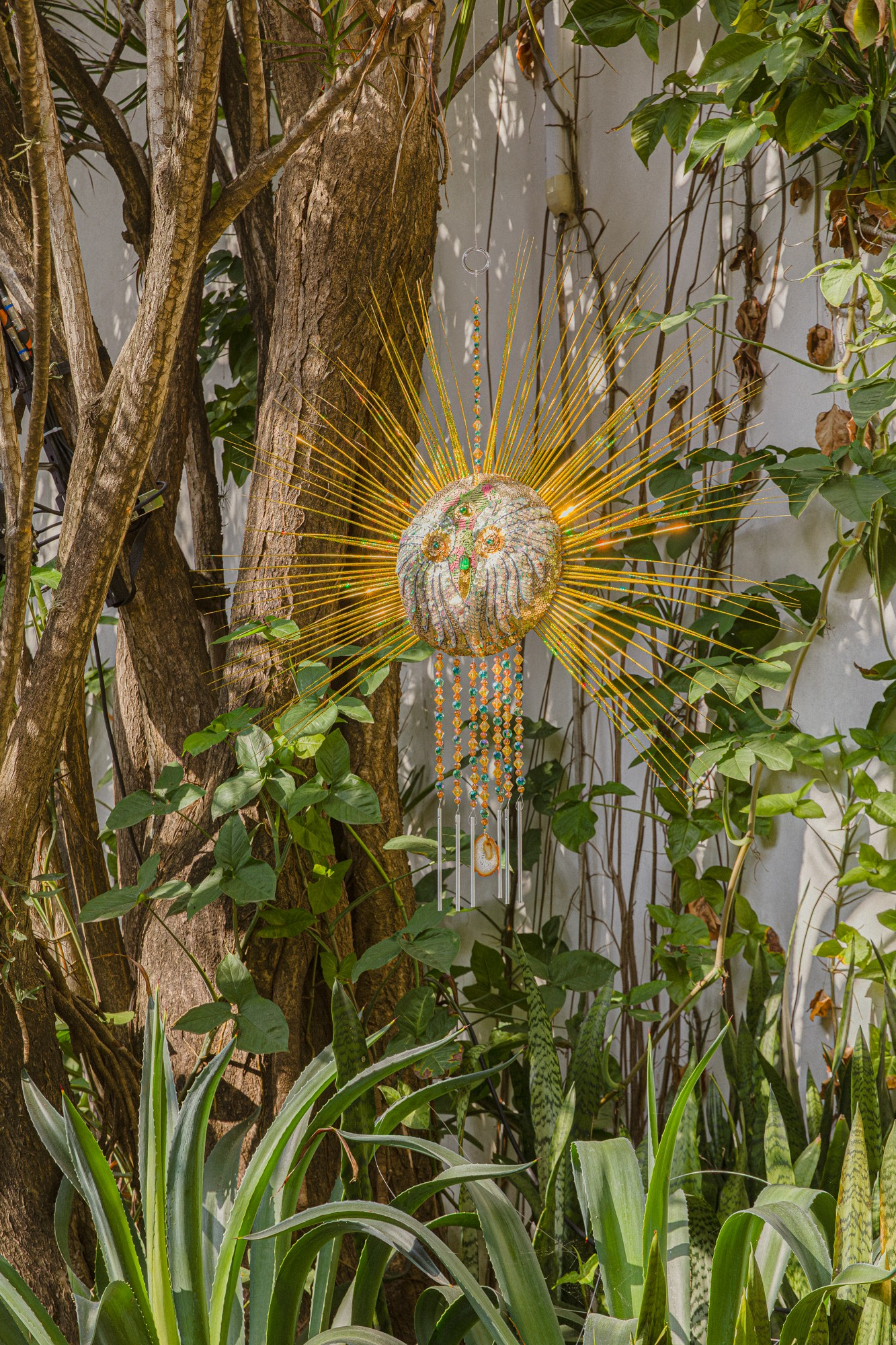
A TRANSÄLIEN
Magic EyeInstallationMixed media
Mandala from
the Reflections SeriesMirrors, branches, trims, and braided cords embroidered onto
sequin fabricVariable dimensions
A Transälien launches us into a spatial crossing that, paradoxically, leads us back into ourselves. Like the portal of a crossroads, Magic Eye investigates the third eye as a site of expanded perception, bringing together spirituality, neuroscience, and pedagogy in an interactive experience that shifts vision into the realm of cosmoperception. Through reflections, shimmer, and responsive surfaces, the work invites viewers to cross thresholds — from inside to outside, from body to universe — activating states of consciousness that unsettle these boundaries. Within each eye, oracular inscriptions emerge as possible antidotes, calling for healing, reconnection, and the collective reinvention of ways of inhabiting the Earth.
It is through this passage that the work asserts itself as both a generous and insurgent gesture: a playful experience that transfigures bodies and invites us to encounter the world through the gaze of another — the gaze of A Transälien. In a vibrant, festive, fractal allegory, laughter, play, and recreation operate as forces of resistance, establishing a pedagogy of the senses that displaces certainties, scrambles hierarchies, and opens pathways toward multiple forms of existence.
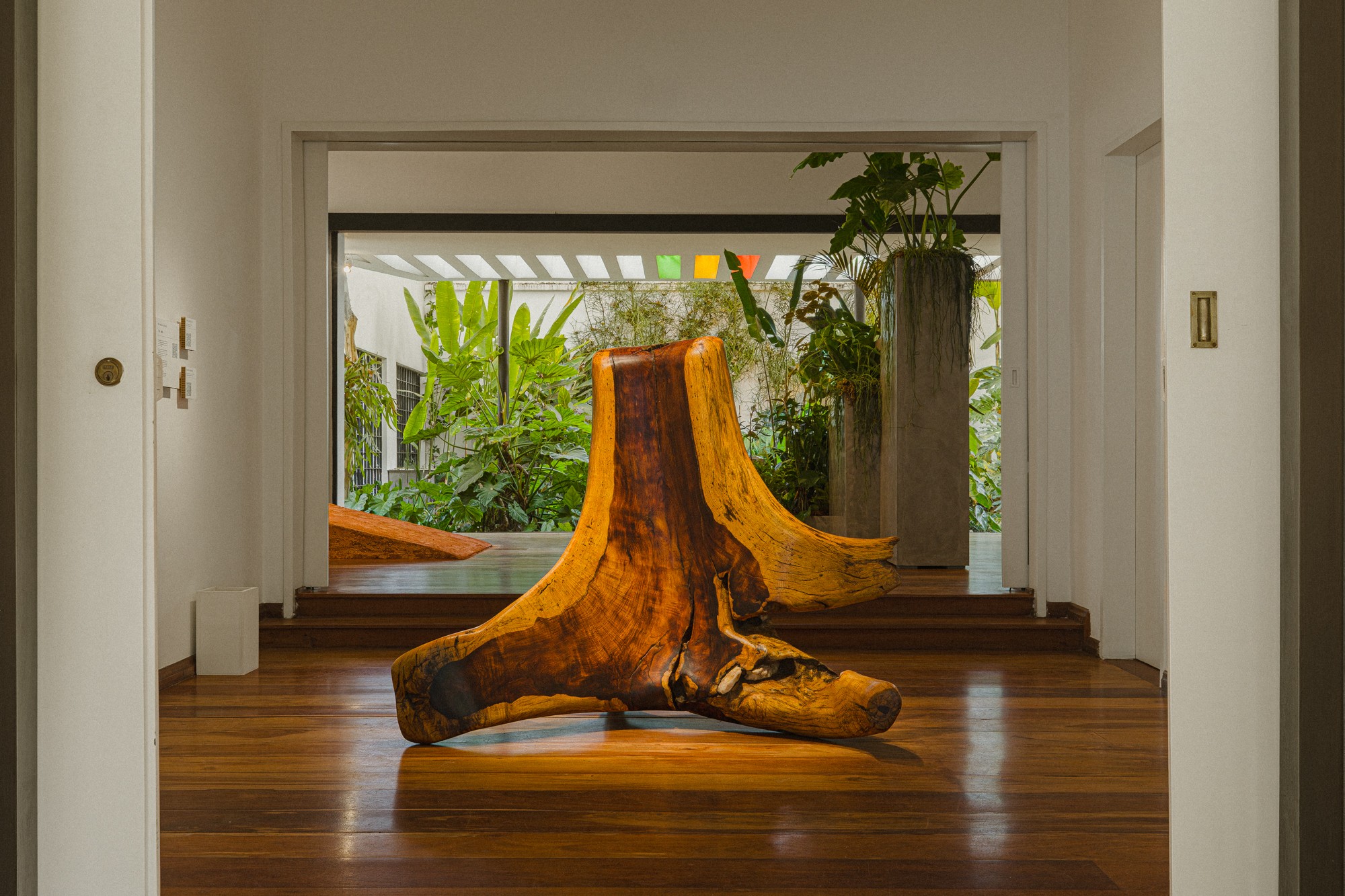
ALESSANDRA VINKSNAITIS
& LOUISE MARTINS
In MemoriamFragrance diluted in alcohol dispersed through a diffuser
A WAY OF EXPANDING LIFE
Each part composes the whole, and the whole is always greater than the sum of its parts.
Here, the jacaranda: an organism that, while alive, formed part of the system surrounding it, yet nearly became only a memory due to the value of its wood and its vulnerability in the face of human greed.
Here, a fragment of this jacaranda — a part that evokes the entirety of its existence. Through it, we access its surroundings: an olfactory landscape that recalls the memories this material carries from its habitat. By inhaling this context, we share an experience of the past and come to inhabit, even if only for an instant, that space together.
Nature always manifests itself as both presence and memory.
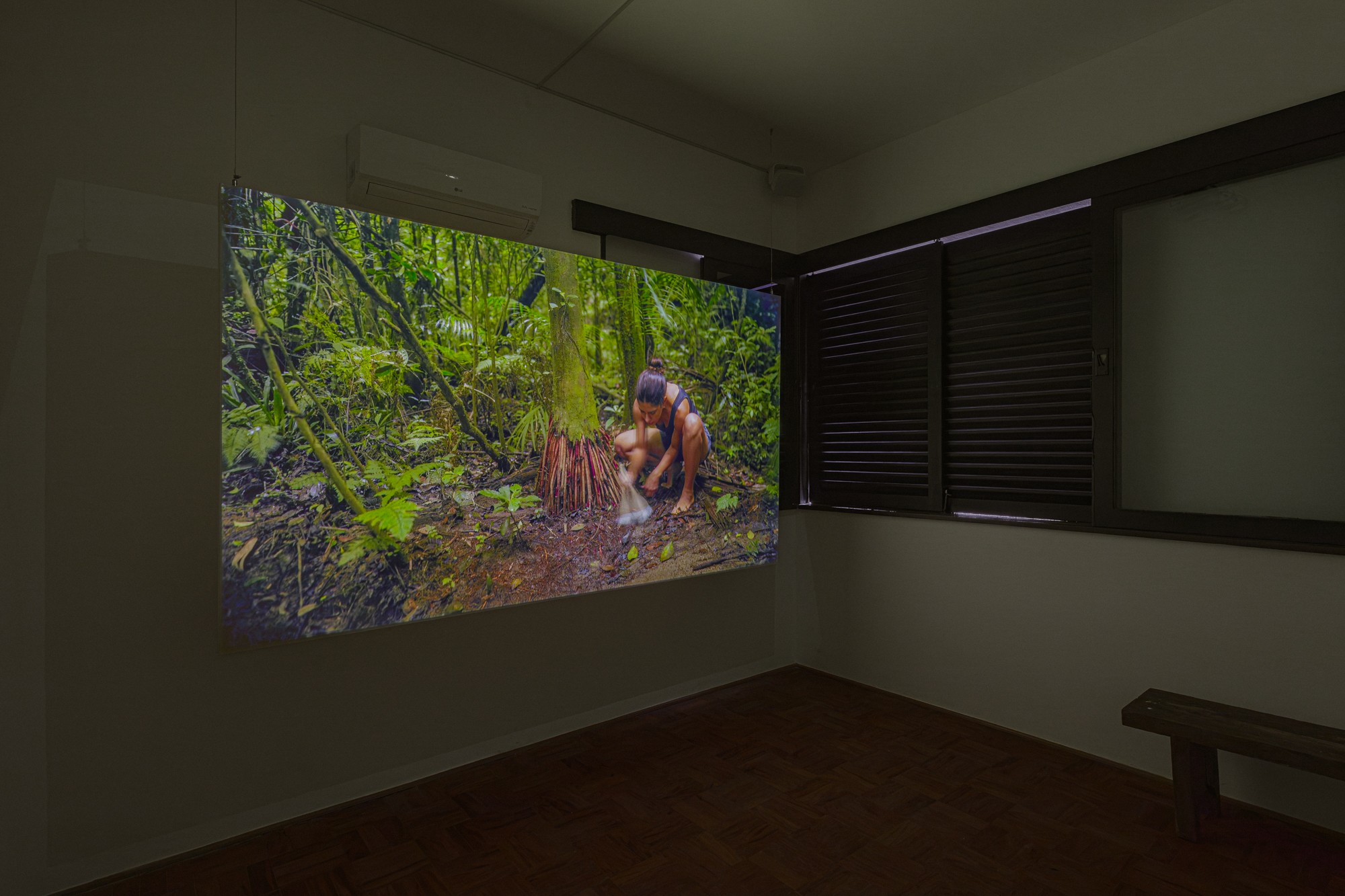
BEATRIZ LINDEMBERG
Environmental Works Series2026Video capture: Patrícia Araújo
SweeperVideo – 2'55"
HangerVideo – 2'26"
DusterVideo – 4'06"
From the encounter between the Atlantic Forest, the body, and gesture emerges a field of investigation that expands the notion of care while revealing an invisible thread connecting domestic and natural ecosystems. By sweeping leaves around a tree, hanging them on a vine clothesline, or dusting the roots of a juçara palm, the artist displaces everyday domestic actions into nature, revealing that just as forests purify water, regulate climate, and sustain life, domestic labor — cooking, cleaning, caring, organizing — also ensures human well-being and constitutes an essential foundation for economic development and the maintenance of life.
By bringing these dimensions into proximity, the work unveils the deep structures through which patriarchy and capitalism intertwine, making evident that the exploitation of the land moves hand in hand with the exploitation of women’s bodies and labor. Within this field of correspondences, Environmental Works — Sweeper, Hanger, and Duster — emerges as an act of restitution and insurgency, returning to nature the care we receive from it. Through a slow, attentive, and repeated gesture, Beatriz inscribes another ethics: one that affirms the recognition of rights, challenges the boundaries of what is understood as productive labor, and repositions care for life as a central, urgent, and deeply political practice.
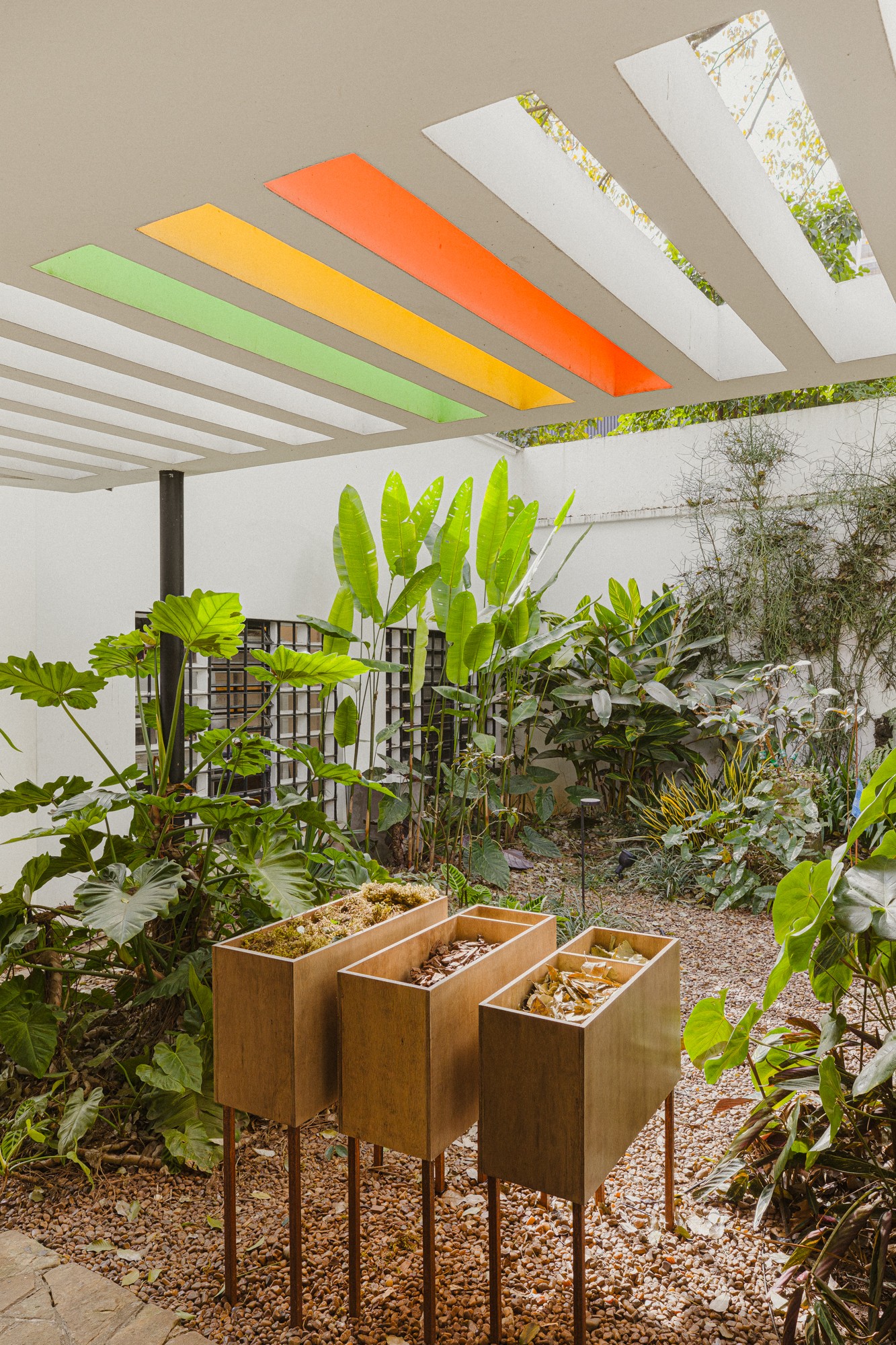
EDBRASS BRASIL
Resonant FlowerbedsSite-specific sound-chromatic installation with light filters2026
Resonant Flowerbeds is a site-specific installation that investigates the synesthetic correspondences between sound and color, proposing an intimate dialogue in which sonic frequency finds its visual translation in organic matter and in the very light that bathes the space. The work emerges from the poetic hypothesis that color is a frequency we can see, while sound is a color we can hear. The installation materializes this correspondence by setting natural chromatic palettes into vibration in response to sonic stimuli, creating a field of visual resonance in which viewers may contemplate the translation of the audible into the visible.
Organic materials — leaves, fibers, seeds — are arranged according to a chromatic score that responds both to the emitted frequencies and to the filtered light. Colors thus become visual receptors of sound, amplifying the perception that what we hear may also be seen, and that what we see carries within it a latent sonic vibration.
GRAMÁTICAS DA NATUREZA
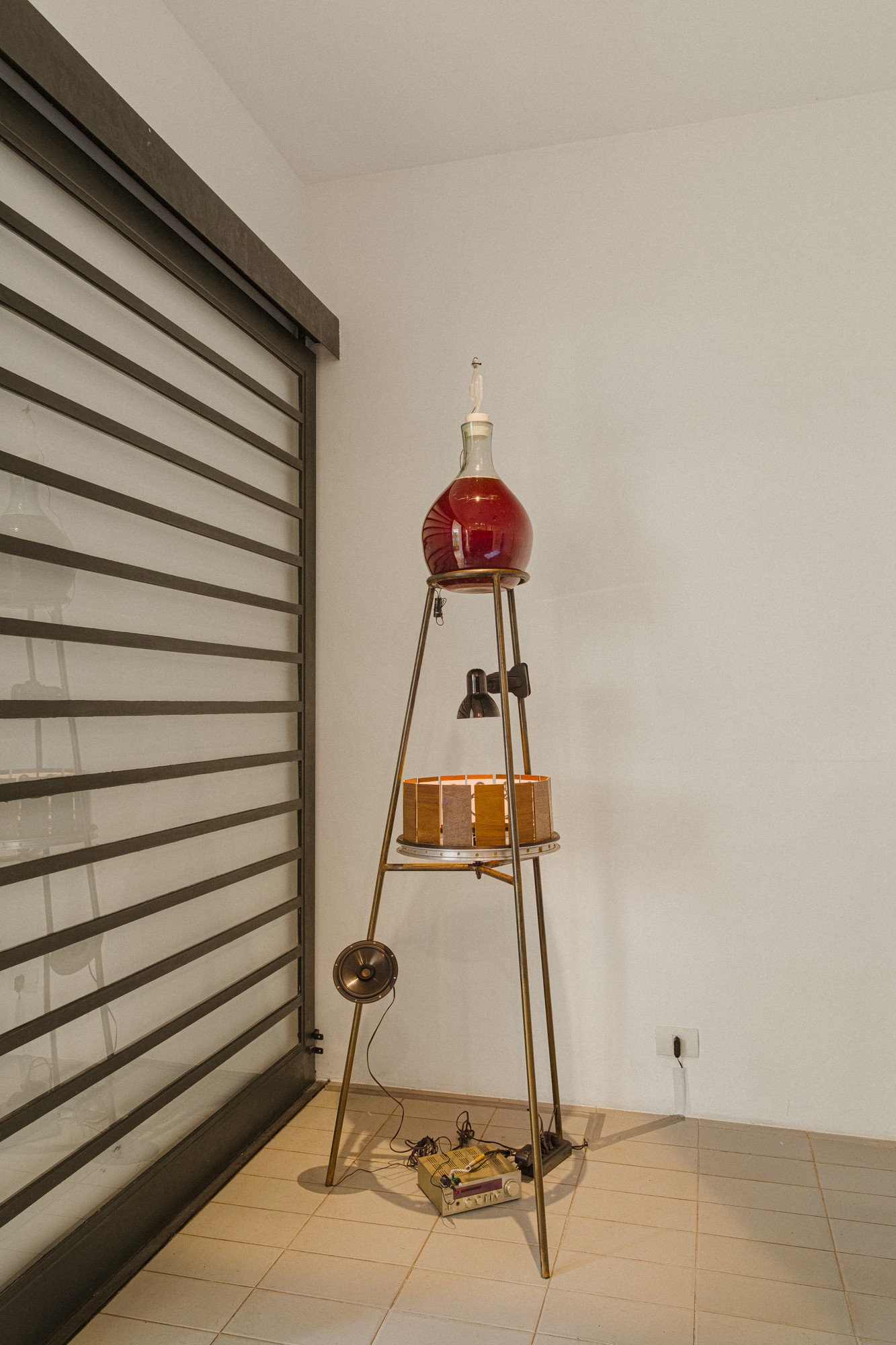
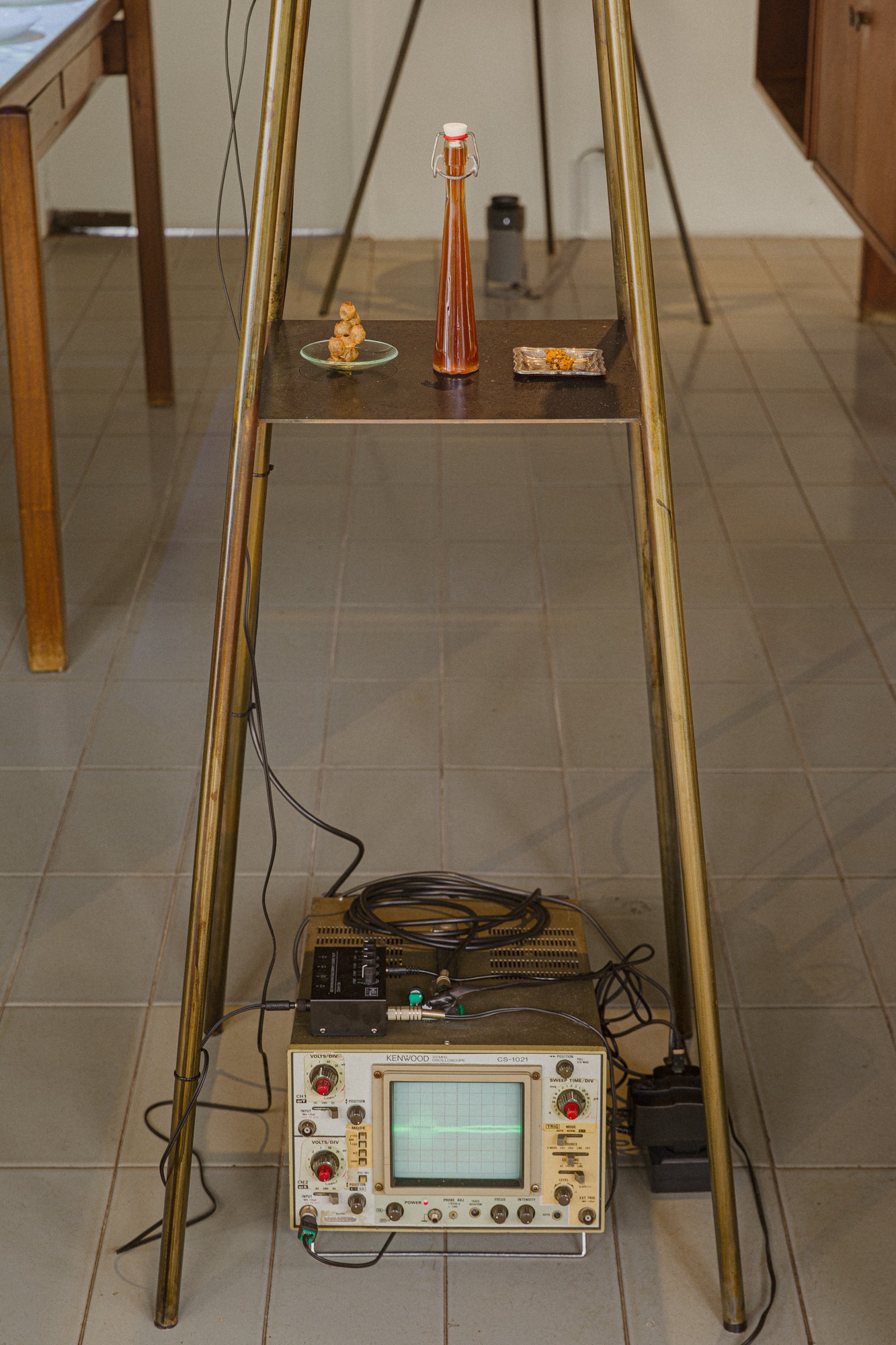
KitchenSteel, glass, wood, video, Pleurotus ostreatus fungus, wild bacteria, chickpeas, and Tetragonisca angustula beesVariable dimensions2026
Kitchen investigates ecosystemic relations through choreographies of cultivation: sequences of gestures that, over time, sustain life. Cultivation is understood here as a form of devotional craftsmanship, guided by repetition, attention, and care, capable of producing food, shelter, healing, and continuity. The work is grounded in the understanding that we have never been autonomous individuals, but rather multispecies compositions — bodies formed through alliances, exchanges, and coevolution. Within this context, cultivation emerges as a practice of cohabitation: an act that sustains life while revealing the interdependence among organisms, in which producing food, shelter, or matter also means participating in symbiotic networks that connect the intimate to the planetary.
The installation thus proposes the exhibition space as a living field of interactions, where different forms of existence — human and nonhuman — intertwine through ongoing processes of mutual sustenance. Between the domestic and the cosmic, the home becomes an expanded organism, permeable to the dynamics of the Earth.
MÔNICA VENTURA
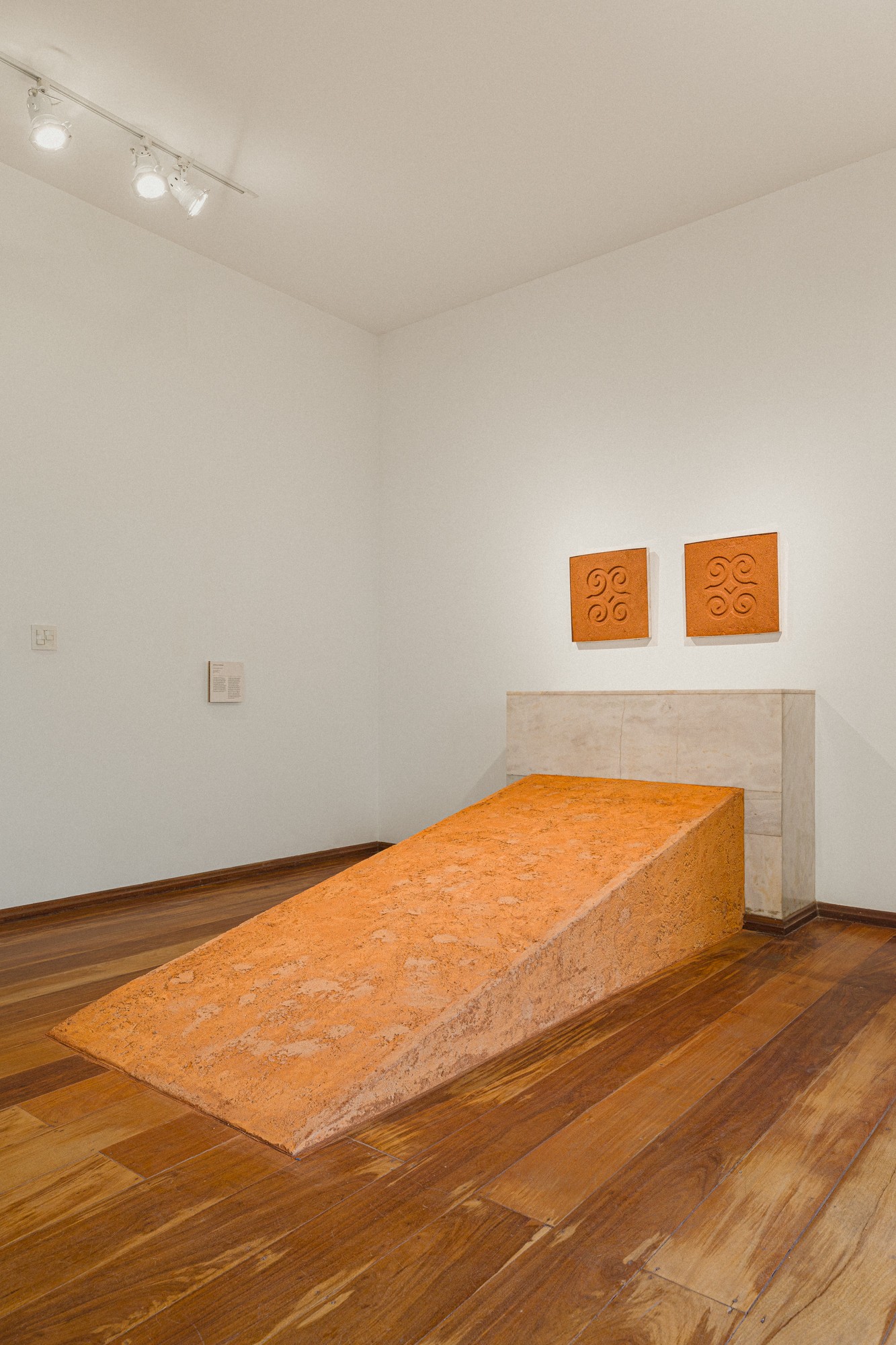
The Ground Dreams TooRammed earth and earthen coatingWall: 50×50 cmRamp: 270×120×65 cm
2026
What does the earth contain? Not only minerals, water, and air, but layers of time, bodies, and sedimented histories. The earth is a living archive — a material upon which the continuities of worlds that have been exploited, displaced, and yet persist are inscribed. Within it coexist microorganisms, roots, decomposition, and rebirth, but also the traces of power relations that have determined who could cultivate, inhabit, and domesticate the landscape: a cosmic choreography between humans and more-than-humans shaping space and giving rhythm to time.
By mobilizing taipa (rammed earth), an ancestral building technique, Mônica Ventura reinscribes within the exhibition space an architecture that does not separate matter from life, technique from cosmology. The gesture of installing a diagonal monolith cutting across the room asserts presence and summons memory, establishing a field of tension in which structures balance within a delicate interplay between support and porosity. The work reactivates the traces of other architectures — those that breathe, transform, and come into being through relation. In contrast to the rigidity of modern thought, with its investment in concrete, purity of form, and ideals of permanence, Ventura proposes a living, unstable, and permeable architecture in which matter is not fixation, but a process of care.
NOVÍSSIMO EDGAR
Instruments Against Anxiety Series2026
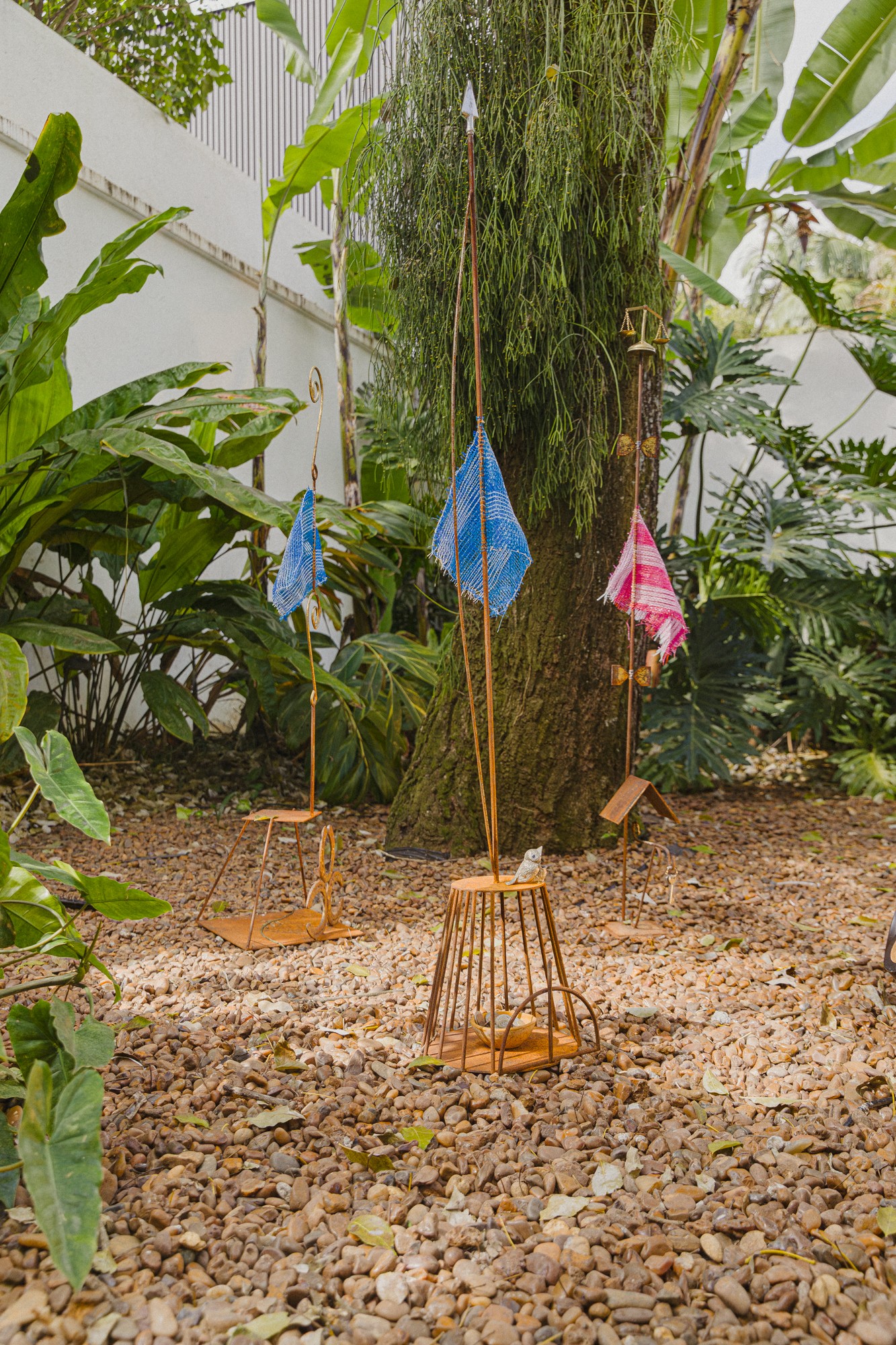
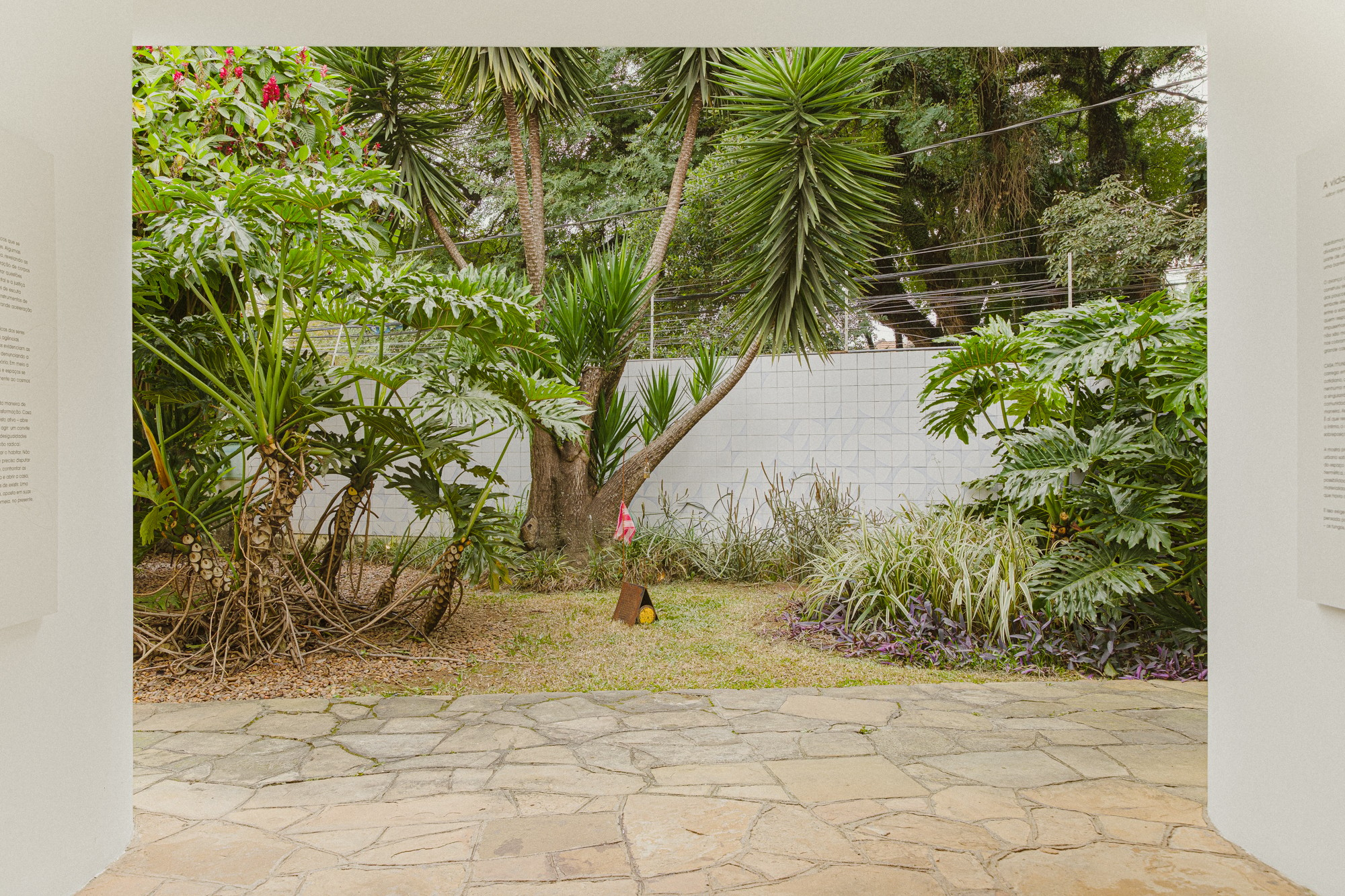
OxóssiGalvanized steel plate, brass, aluminum, façade mesh, clay plate, coins, cowrie shells, and gold leaf
OgumGalvanized steel plate, façade mesh, horseshoe, and gold leaf
ExuGalvanized steel plate, iron cylinder, façade mesh, padlock, and gold leaf
XangôGalvanized steel plate, brass scale, keys, and gold leaf
There is no neutral ground. Space — whether domestic, urban, cultivated, or forested — is continuously produced through regimes of power that organize permanence and displacement, determining who may occupy it, for how long, and under what conditions. Within urban contexts marked by expropriation, speculation, and territorial control, the idea of stability reveals itself as a fragile construction, sustained by historical inequalities and by the uneven distribution of the rights to land, to the city, and to life itself. It is within this contested terrain that Novíssimo Edgar presents Instruments Against Anxiety, a series of sculptures that seeks to evoke states of presence and balance while rehearsing provisional forms of anchoring.
Like monuments of offering, the sculptures mobilize symbolic elements associated with the orixás, traversing spatialities and temporalities in order to situate us at the crossroads — a site of encounter, negotiation, and dispute. Executed in iron and conceived for outdoor settings, the works expose themselves to the action of time: oxidation and weathering do not operate as deterioration, but as the material and symbolic continuation of the work itself. At their apex, fragments of protective construction mesh are reconfigured as flags — not to assert dominion, but to render visible the unstable boundaries of a territory in permanent dispute.
RENATA PADOVAN
Ancestral Grafias Series
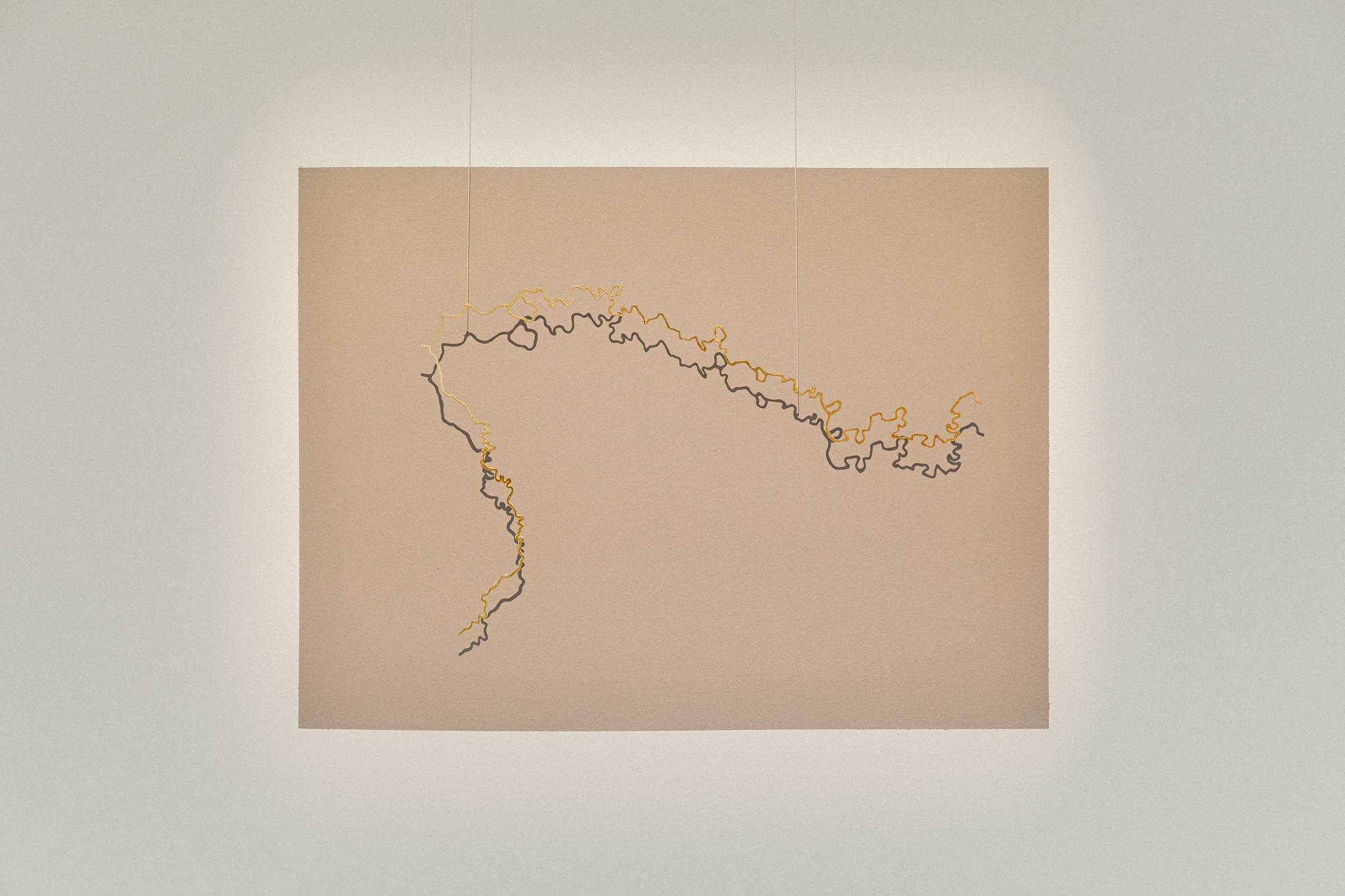
Tietê and PinheirosGold-plated steel sculpture
30×18 cm2026
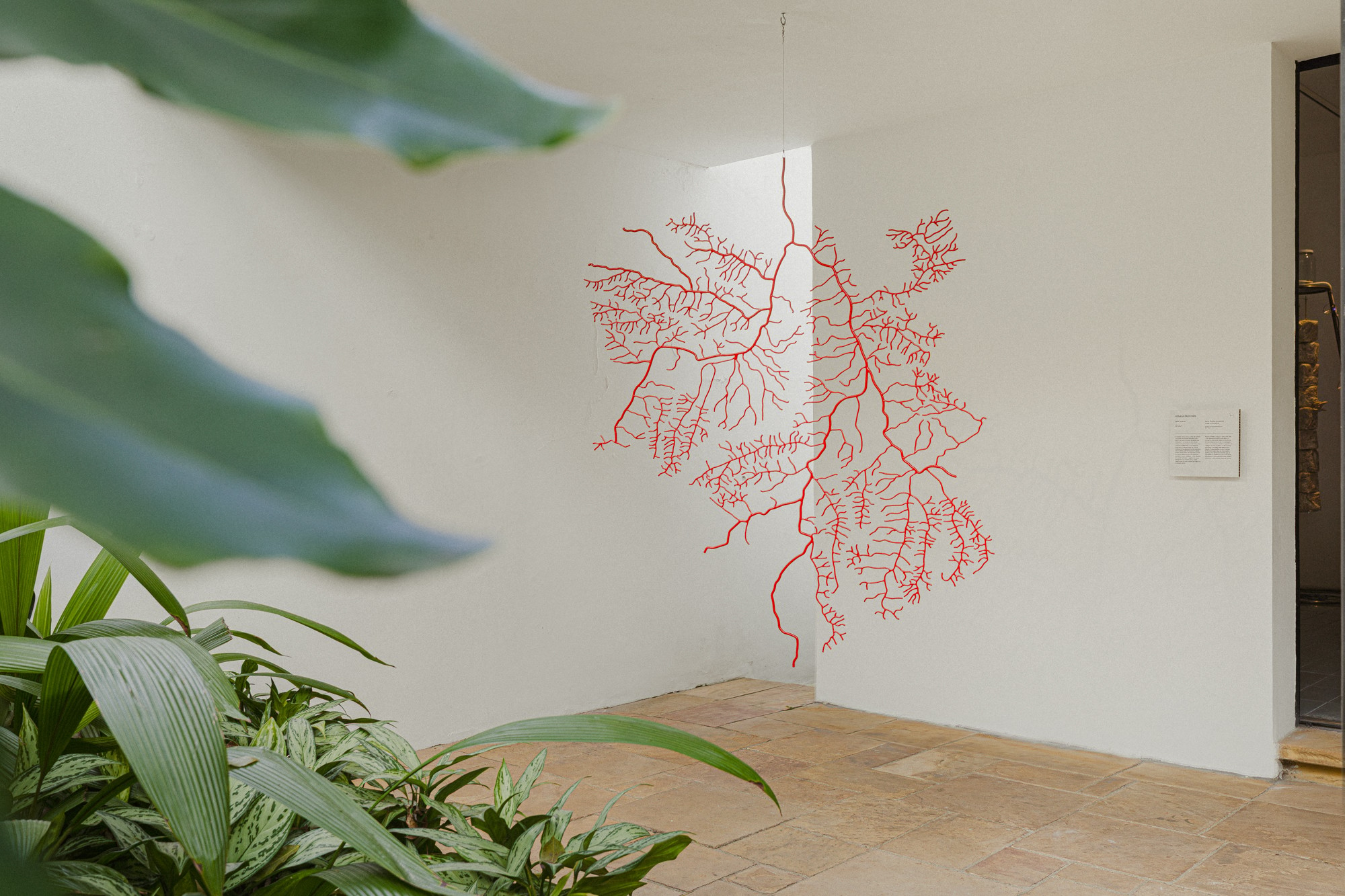
Arteries SeriesSteel mobile
160×140 cm
The project takes as its starting point the courses of the Pinheiros and Tietê Rivers and their countless tributaries that cut across the city of São Paulo. Once winding, these waterways had their meanders straightened and canalized, while the extensive network of smaller streams was progressively buried beneath asphalt, remaining invisible yet still active. The curved traces that once mapped their flow persist as vestiges — a kind of territorial writing — recording erased currents that continue to exist, even if they can no longer be seen within the contemporary landscape.
Within this context, water — the cradle of life — not only conceals but also retains and preserves memory, bearing witness to human transformations imposed upon the landscape. Like a body that remembers and safeguards the traces of rivers that have been contained or silenced, to listen to them is to access this latent testimony. It is in this sense that Renata’s work suggests that the rivers file a complaint: a sensitive form of denunciation manifested through the persistence with which they continue to overflow, reclaiming their ancient paths and the freedom of their forms.
ROBINHO SANTANA
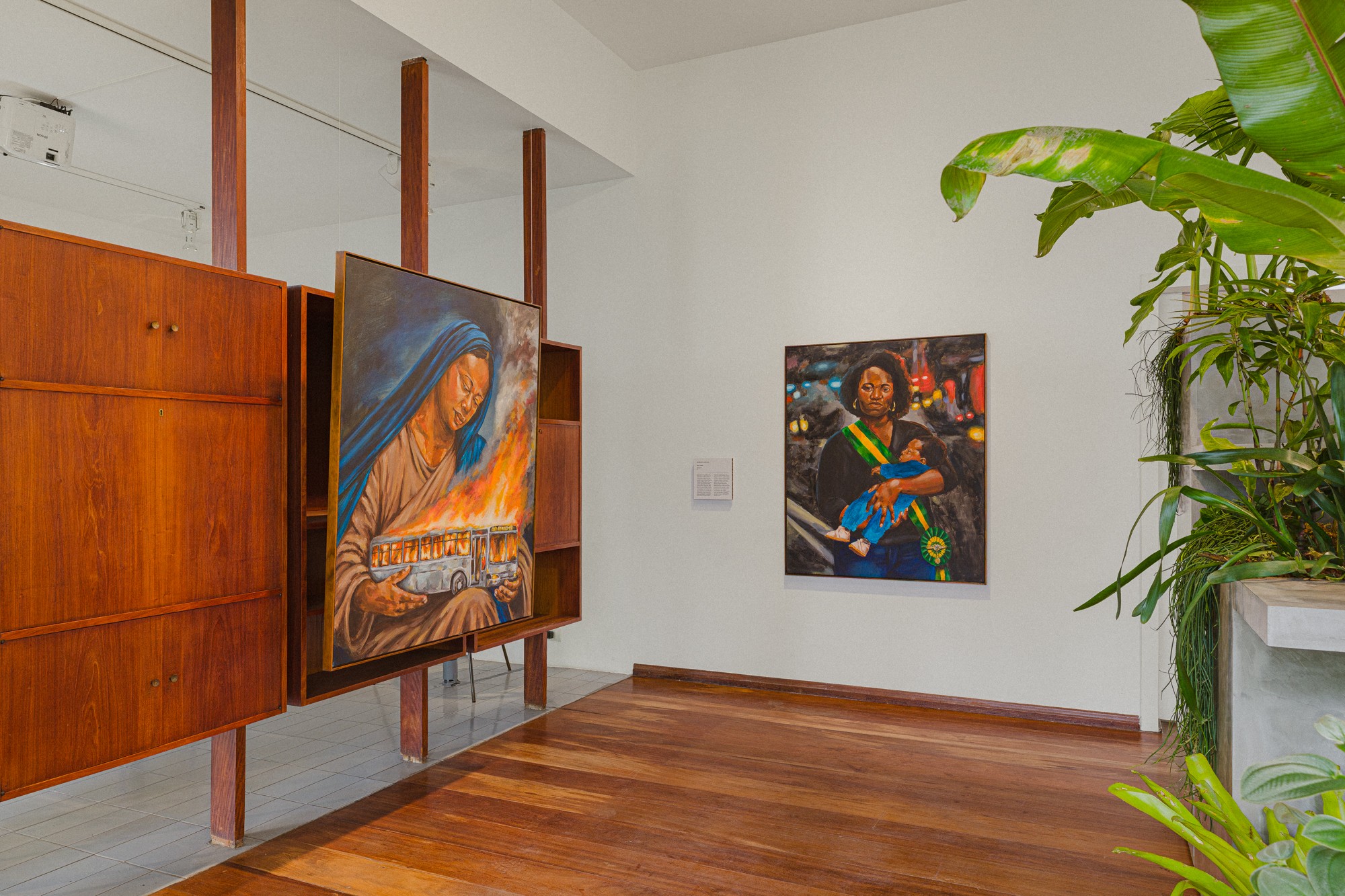
Pietà and MatriaAcrylic on canvas105×125 cm2026
Presented as a diptych, Pietà and Matria shifts the debate surrounding the climate crisis toward the peripheral territories of Brazil, where collapse is not a future scenario, but an everyday experience. The works are constructed through the gathering of fragments — discourses, images, lived experiences — emerging from the margins in order to reveal how climate impacts fall unevenly upon Black and historically marginalized bodies. Through this gesture, they activate an ecology of knowledges in which peripheral experience asserts itself as language, memory, and a form of epistemic production. Amid floods, extreme heat, precarious mobility, and infrastructural neglect, what emerges is not only inequality, but also the power of lives that persist and reinvent themselves, developing their own technologies and strategies to sustain, day after day, the continuity of life.
In Pietà, the classical image is reconfigured: instead of Christ’s body, a burning bus condenses the collective experience of collapse, becoming a symbol of everyday exhaustion and structural abandonment. In Matria, the maternal figure sustains life within the urban landscape, articulating care and permanence as political gestures. The presence of the presidential sash places structures of power and representation under tension, asserting the urgency of other voices and alternation of political power. Together, the works reverse the dominant perspective on the climate crisis, proposing that the future be imagined from the standpoint of those already living its effects — not merely as victims, but as subjects capable of imagining and constructing other forms of collective existence.
The Atlantic Forest
InstallationMixed media2026
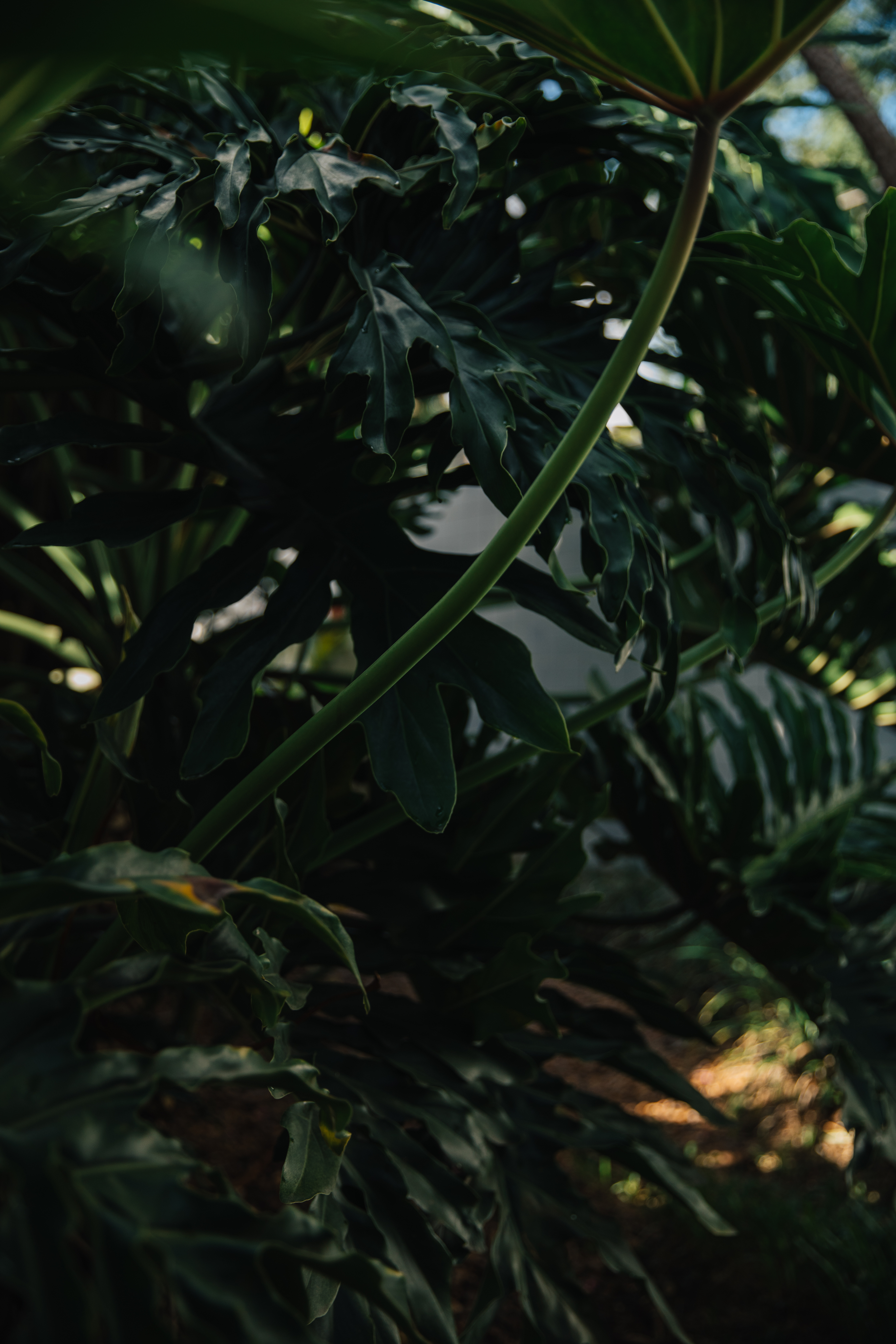
In the heart of the house, the forest dwells.The Atlantic Forest exhibit brings together 22 native species of this biome, bringing into the exhibition living beings that carry within them the profound memory of the forest that once occupied this territory. Many of these plants were born in Legado das Águas, the largest private reserve of Atlantic Forest in Brazil, and arrive at the house as beings of the forest itself, carrying its time, its humidity, its rhythms and relationships.Jussaras, orelha-de-onça, pacovás, canas-do-brejo, gingers-azuis, marantas and anthuriums do not appear here as decorative elements, but as living entities. Forest-beings that for thousands of years have learned to coexist in diversity, sharing space, light, water and shade in delicate systems of balance.By occupying the center of the house, these plants bring the forest closer to the domestic environment and invite us to imagine other forms of coexistence between humans and nature. Their presence transforms the space: it alters the light, the air, the perception of time, and reminds us that the original Atlantic Forest was also part of this territory long before the city.After the exhibition, the plants will remain alive. They will be donated to projects for reforestation in public squares in the city of São Paulo, returning part of these forest-like beings to the urban landscape and expanding their possibilities of encounter with other human and non-human life forms.
ENGLISH VERSION
EXHIBITION TEXTS

Life is wild, and it also erupts in the city.
— Ailton Krenak
We inhabit different homes. The body, the dwelling, and the world we share with countless other beings. We are part of a whole, yet we persist in the fantasy that a barrier exists between nature and humanity.
The expansion of cities has normalized this separation; it has built structures of comfort that have gradually distanced us from the living system of which we are a part. A silent conflict has taken hold: between self and other, between survival and life. And nature responds with the very force upon which we imposed our civilization. Climate change is no longer a warning on the horizon. It is reality. And it demands something of us: that we rethink how we inhabit this great common home.
Casa Mundo Particular emerges from this tension. The title itself carries the structure of the project: CASA [home] names the everyday, intimacy, shelter. MUNDO [world] reminds us that no dwelling exists in isolation. PARTICULAR [particular] points to the singularity of each gaze — each person, artist, and community inhabiting this entanglement in their own way. The three words function in any order. Therein lies their strength: there is no fixed hierarchy between the intimate, the collective, and the planetary. There is circulation, friction, overlap, communion.
The exhibition proposes a movement contrary to urban expansion over green space — a symbolic reforestation of the domestic sphere. A house that ceases to be hermetic, solid, immutable, and instead allows itself to be contaminated by living possibilities: organic elements, memories, materialities that enter through its rooms and awaken what had lain dormant.
And this demands a shift in perception: what if the house were not designed for those who visit it, but for those who already inhabit it — fungi, roots, the light that enters at a low angle at six in the evening? Multispecies theory asks precisely this of us: to remove the human from the center and cultivate an empathetic imagination capable of entering other temporalities, other perceptions, other ways of growing. While scientists and politicians negotiate targets, art proposes something else: changing what we are capable of imagining.
The very site chosen to host the exhibition carries its own layers of meaning. Apartamento 61 occupies a residence designed in 1939 by Victor Brecheret — where the sculptor lived with his family — and renovated two decades later by Rino Levi. Dedicated to the preservation of twentieth-century Brazilian furniture, the gallery’s history already contains many of the questions raised by the exhibition itself: architecture, ecological thinking, circular economy. Yet this history does not remain a backdrop. The architecture affects the works; the works affect the architecture. Between space, object, and visitor, an ecology of relations takes shape.
The exhibition is curated by Lilian Fraiji. Born in the Amazon, she brings together art, nature, science, and ancestral knowledge, with particular attention to the relationships between culture, climate, and environmental justice. Hers is a perspective that inhabits, as the exhibition proposes, more than one home at once.
Casa Mundo Particular asserts itself as a territory of encounter and listening. A space where art, ecology, and architecture intertwine not to offer answers, but to cultivate questions: how might we coexist in more sensitive and sustainable ways? What forms of belonging remain possible? How do we inhabit the world beyond the logic of separation?
By proposing an experience that moves through both the sensory and the political, the project establishes a field of reflection in which care for life — in all its diversity — expands beyond the walls themselves. A house that breathes, welcomes, and opens itself: to the other, to time, and to the world.
Stefania Dzwigalska
Creator of Casa Mundo Particular
The opposite of life is not death,
but disenchantment.
— Luiz Rufino, Flecha no Tempo [Arrow Through Time]
The home is a possible space of shared and collective happiness, a catalogue of a possible world made of things, emotions, objects, people, plants, and animals. It is the intimate space of who we are, where the values we believe in take shape and where our lives intertwine with other lives, our destinies with other destinies. It is within the domestic sphere that we express and practice love, extending affection beyond the human as part of an ongoing dance of mutual domestication among lives, objects, and memories. If the home is a place for the exercise of love, sharing, and the creation of common worlds, how can we make the planet our home?
Casa Mundo Particular emerges from this question as a political gesture in favor of care — a call for the creation of spaces of renewal where we may imagine and practice, with courage and attentiveness, the future we desire. The exhibition proposes a displacement of the very notion of inhabiting, dissolving the boundaries that separate inside from outside, the intimate from the collective, the human from the nonhuman, in order to ground dwelling within the Earth itself. To inhabit, here, is to feel oneself woven into a continuous web of relations; it is to recognize oneself as part of a world that breathes alongside us, where interdependence ceases to be a concept and reveals itself as a condition of existence.
A house built as a territory of expanded perception — a space of listening to all that does not speak, of seeing what has not yet revealed itself, of opening oneself to what is felt before it can be named. A place where we allow ourselves to be affected, enveloped, and transformed; where we relearn how to become enchanted by the language of the world and by the living beauty that surrounds us. Here, encounter becomes a force, and through it we recognize ourselves implicated in what we are: relational, multiple, interconnected, and multispecies beings.
We have brought together a group of artistic works united by the power of cultivating becoming. Some emerge as gestures of denunciation, revealing the deep structures that connect the exploitation of human bodies and nature, resonating with questions of ecofeminism, environmental racism, and climate justice. Others unfold as fields of expanded listening and spirituality, important instruments for reconnecting with the Earth in times of the great acceleration of the Capitalocene. Some works delve into the dynamics of living beings in all their complexity, revering the invisible agencies of the microcosm, while others expose the marks of human intervention upon the landscape, denouncing the historical violence inscribed in rivers that remember. Amid displacements and transfigurations, bodies and spaces intertwine, projecting us simultaneously toward the cosmos and inward into ourselves.
If living is an ecological act, then every mode of inhabiting carries within it the potential for transformation. Casa Mundo Particular asserts itself as an active gesture — opening a field in which imagining is already a form of action: an invitation to cultivate other presences, to confront inequalities in the right to life, and to assume a radical implication in the world. To reenchant the home is also to resignify inhabiting itself. It is not enough to recognize interdependence; it is necessary to dispute its forms, intervene in its organization, confront the historical violences that silence life, and open the house, the body, and thought itself to other ways of existing. A sensitive house that dreams and insists upon life, that believes in its inventions, trusts in metamorphosis, and sows, in the present, other ways of living together.
Lilian Fraiji
Curator
ARTWORKS
A TRANSÄLIEN
Magic EyeInstallationMixed media
Mandala from
the Reflections SeriesMirrors, branches, trims, and braided cords embroidered onto
sequin fabricVariable dimensions
A Transälien launches us into a spatial crossing that, paradoxically, leads us back into ourselves. Like the portal of a crossroads, Magic Eye investigates the third eye as a site of expanded perception, bringing together spirituality, neuroscience, and pedagogy in an interactive experience that shifts vision into the realm of cosmoperception. Through reflections, shimmer, and responsive surfaces, the work invites viewers to cross thresholds — from inside to outside, from body to universe — activating states of consciousness that unsettle these boundaries. Within each eye, oracular inscriptions emerge as possible antidotes, calling for healing, reconnection, and the collective reinvention of ways of inhabiting the Earth.
It is through this passage that the work asserts itself as both a generous and insurgent gesture: a playful experience that transfigures bodies and invites us to encounter the world through the gaze of another — the gaze of A Transälien. In a vibrant, festive, fractal allegory, laughter, play, and recreation operate as forces of resistance, establishing a pedagogy of the senses that displaces certainties, scrambles hierarchies, and opens pathways toward multiple forms of existence.
ALESSANDRA VINKSNAITIS
& LOUISE MARTINS
In MemoriamFragrance diluted in alcohol dispersed through a diffuser
A WAY OF EXPANDING LIFE
Each part composes the whole, and the whole is always greater than the sum of its parts.
Here, the jacaranda: an organism that, while alive, formed part of the system surrounding it, yet nearly became only a memory due to the value of its wood and its vulnerability in the face of human greed.
Here, a fragment of this jacaranda — a part that evokes the entirety of its existence. Through it, we access its surroundings: an olfactory landscape that recalls the memories this material carries from its habitat. By inhaling this context, we share an experience of the past and come to inhabit, even if only for an instant, that space together.
Nature always manifests itself as both presence and memory.
BEATRIZ LINDEMBERG
Environmental Works Series2026Video capture: Patrícia Araújo
SweeperVideo – 2'55"
HangerVideo – 2'26"
DusterVideo – 4'06"
From the encounter between the Atlantic Forest, the body, and gesture emerges a field of investigation that expands the notion of care while revealing an invisible thread connecting domestic and natural ecosystems. By sweeping leaves around a tree, hanging them on a vine clothesline, or dusting the roots of a juçara palm, the artist displaces everyday domestic actions into nature, revealing that just as forests purify water, regulate climate, and sustain life, domestic labor — cooking, cleaning, caring, organizing — also ensures human well-being and constitutes an essential foundation for economic development and the maintenance of life.
By bringing these dimensions into proximity, the work unveils the deep structures through which patriarchy and capitalism intertwine, making evident that the exploitation of the land moves hand in hand with the exploitation of women’s bodies and labor. Within this field of correspondences, Environmental Works — Sweeper, Hanger, and Duster — emerges as an act of restitution and insurgency, returning to nature the care we receive from it. Through a slow, attentive, and repeated gesture, Beatriz inscribes another ethics: one that affirms the recognition of rights, challenges the boundaries of what is understood as productive labor, and repositions care for life as a central, urgent, and deeply political practice.
EDBRASS BRASIL
Resonant FlowerbedsSite-specific sound-chromatic installation with light filters2026
Resonant Flowerbeds is a site-specific installation that investigates the synesthetic correspondences between sound and color, proposing an intimate dialogue in which sonic frequency finds its visual translation in organic matter and in the very light that bathes the space. The work emerges from the poetic hypothesis that color is a frequency we can see, while sound is a color we can hear. The installation materializes this correspondence by setting natural chromatic palettes into vibration in response to sonic stimuli, creating a field of visual resonance in which viewers may contemplate the translation of the audible into the visible.
Organic materials — leaves, fibers, seeds — are arranged according to a chromatic score that responds both to the emitted frequencies and to the filtered light. Colors thus become visual receptors of sound, amplifying the perception that what we hear may also be seen, and that what we see carries within it a latent sonic vibration.
GRAMÁTICAS DA NATUREZA
KitchenSteel, glass, wood, video, Pleurotus ostreatus fungus, wild bacteria, chickpeas, and Tetragonisca angustula beesVariable dimensions2026
Kitchen investigates ecosystemic relations through choreographies of cultivation: sequences of gestures that, over time, sustain life. Cultivation is understood here as a form of devotional craftsmanship, guided by repetition, attention, and care, capable of producing food, shelter, healing, and continuity. The work is grounded in the understanding that we have never been autonomous individuals, but rather multispecies compositions — bodies formed through alliances, exchanges, and coevolution. Within this context, cultivation emerges as a practice of cohabitation: an act that sustains life while revealing the interdependence among organisms, in which producing food, shelter, or matter also means participating in symbiotic networks that connect the intimate to the planetary.
The installation thus proposes the exhibition space as a living field of interactions, where different forms of existence — human and nonhuman — intertwine through ongoing processes of mutual sustenance. Between the domestic and the cosmic, the home becomes an expanded organism, permeable to the dynamics of the Earth.
MÔNICA VENTURA
The Ground Dreams TooRammed earth and earthen coatingWall: 50×50 cmRamp: 270×120×65 cm
2026
What does the earth contain? Not only minerals, water, and air, but layers of time, bodies, and sedimented histories. The earth is a living archive — a material upon which the continuities of worlds that have been exploited, displaced, and yet persist are inscribed. Within it coexist microorganisms, roots, decomposition, and rebirth, but also the traces of power relations that have determined who could cultivate, inhabit, and domesticate the landscape: a cosmic choreography between humans and more-than-humans shaping space and giving rhythm to time.
By mobilizing taipa (rammed earth), an ancestral building technique, Mônica Ventura reinscribes within the exhibition space an architecture that does not separate matter from life, technique from cosmology. The gesture of installing a diagonal monolith cutting across the room asserts presence and summons memory, establishing a field of tension in which structures balance within a delicate interplay between support and porosity. The work reactivates the traces of other architectures — those that breathe, transform, and come into being through relation. In contrast to the rigidity of modern thought, with its investment in concrete, purity of form, and ideals of permanence, Ventura proposes a living, unstable, and permeable architecture in which matter is not fixation, but a process of care.
NOVÍSSIMO EDGAR
Instruments Against Anxiety Series2026
OxóssiGalvanized steel plate, brass, aluminum, façade mesh, clay plate, coins, cowrie shells, and gold leaf
OgumGalvanized steel plate, façade mesh, horseshoe, and gold leaf
ExuGalvanized steel plate, iron cylinder, façade mesh, padlock, and gold leaf
XangôGalvanized steel plate, brass scale, keys, and gold leaf
There is no neutral ground. Space — whether domestic, urban, cultivated, or forested — is continuously produced through regimes of power that organize permanence and displacement, determining who may occupy it, for how long, and under what conditions. Within urban contexts marked by expropriation, speculation, and territorial control, the idea of stability reveals itself as a fragile construction, sustained by historical inequalities and by the uneven distribution of the rights to land, to the city, and to life itself. It is within this contested terrain that Novíssimo Edgar presents Instruments Against Anxiety, a series of sculptures that seeks to evoke states of presence and balance while rehearsing provisional forms of anchoring.
Like monuments of offering, the sculptures mobilize symbolic elements associated with the orixás, traversing spatialities and temporalities in order to situate us at the crossroads — a site of encounter, negotiation, and dispute. Executed in iron and conceived for outdoor settings, the works expose themselves to the action of time: oxidation and weathering do not operate as deterioration, but as the material and symbolic continuation of the work itself. At their apex, fragments of protective construction mesh are reconfigured as flags — not to assert dominion, but to render visible the unstable boundaries of a territory in permanent dispute.
RENATA PADOVAN
Ancestral Grafias Series
Tietê and PinheirosGold-plated steel sculpture
30×18 cm2026
Arteries SeriesSteel mobile
160×140 cm
The project takes as its starting point the courses of the Pinheiros and Tietê Rivers and their countless tributaries that cut across the city of São Paulo. Once winding, these waterways had their meanders straightened and canalized, while the extensive network of smaller streams was progressively buried beneath asphalt, remaining invisible yet still active. The curved traces that once mapped their flow persist as vestiges — a kind of territorial writing — recording erased currents that continue to exist, even if they can no longer be seen within the contemporary landscape.
Within this context, water — the cradle of life — not only conceals but also retains and preserves memory, bearing witness to human transformations imposed upon the landscape. Like a body that remembers and safeguards the traces of rivers that have been contained or silenced, to listen to them is to access this latent testimony. It is in this sense that Renata’s work suggests that the rivers file a complaint: a sensitive form of denunciation manifested through the persistence with which they continue to overflow, reclaiming their ancient paths and the freedom of their forms.
ROBINHO SANTANA
Pietà and MatriaAcrylic on canvas105×125 cm2026
Presented as a diptych, Pietà and Matria shifts the debate surrounding the climate crisis toward the peripheral territories of Brazil, where collapse is not a future scenario, but an everyday experience. The works are constructed through the gathering of fragments — discourses, images, lived experiences — emerging from the margins in order to reveal how climate impacts fall unevenly upon Black and historically marginalized bodies. Through this gesture, they activate an ecology of knowledges in which peripheral experience asserts itself as language, memory, and a form of epistemic production. Amid floods, extreme heat, precarious mobility, and infrastructural neglect, what emerges is not only inequality, but also the power of lives that persist and reinvent themselves, developing their own technologies and strategies to sustain, day after day, the continuity of life.
In Pietà, the classical image is reconfigured: instead of Christ’s body, a burning bus condenses the collective experience of collapse, becoming a symbol of everyday exhaustion and structural abandonment. In Matria, the maternal figure sustains life within the urban landscape, articulating care and permanence as political gestures. The presence of the presidential sash places structures of power and representation under tension, asserting the urgency of other voices and alternation of political power. Together, the works reverse the dominant perspective on the climate crisis, proposing that the future be imagined from the standpoint of those already living its effects — not merely as victims, but as subjects capable of imagining and constructing other forms of collective existence.
The Atlantic Forest
InstallationMixed media2026
In the heart of the house, the forest dwells.The Atlantic Forest exhibit brings together 22 native species of this biome, bringing into the exhibition living beings that carry within them the profound memory of the forest that once occupied this territory. Many of these plants were born in Legado das Águas, the largest private reserve of Atlantic Forest in Brazil, and arrive at the house as beings of the forest itself, carrying its time, its humidity, its rhythms and relationships.Jussaras, orelha-de-onça, pacovás, canas-do-brejo, gingers-azuis, marantas and anthuriums do not appear here as decorative elements, but as living entities. Forest-beings that for thousands of years have learned to coexist in diversity, sharing space, light, water and shade in delicate systems of balance.By occupying the center of the house, these plants bring the forest closer to the domestic environment and invite us to imagine other forms of coexistence between humans and nature. Their presence transforms the space: it alters the light, the air, the perception of time, and reminds us that the original Atlantic Forest was also part of this territory long before the city.After the exhibition, the plants will remain alive. They will be donated to projects for reforestation in public squares in the city of São Paulo, returning part of these forest-like beings to the urban landscape and expanding their possibilities of encounter with other human and non-human life forms.